


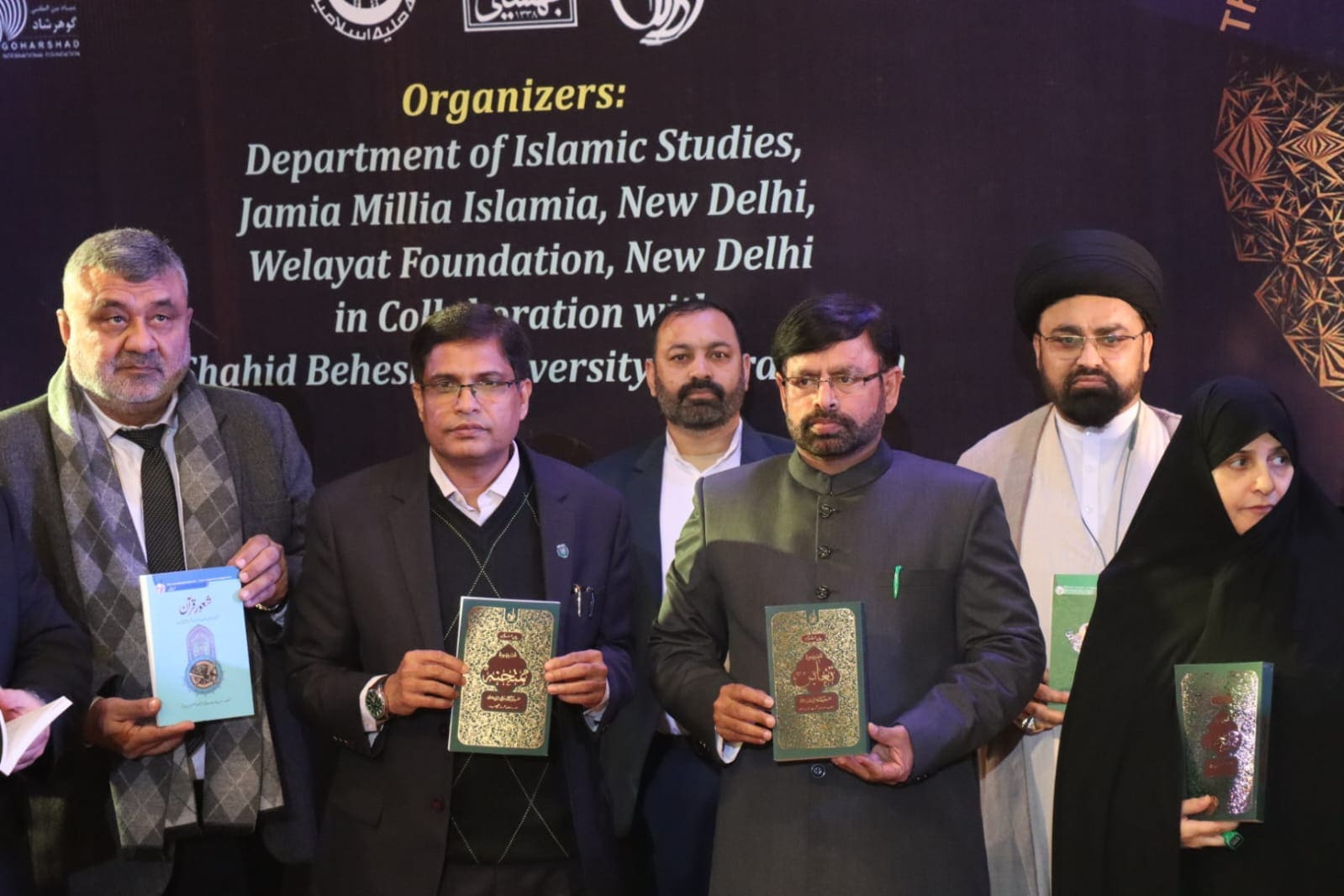
New Delhi, January 29, 2026: A three-day International Conference on “Qur’an and Science” collaboratively organized by the Department of Islamic Studies, Jamia Millia Islamia (JMI), the Wilayat Foundation, and Shahid Beheshti University, Tehran, Iran from January 28 to January 30, 2026, was yesterday inaugurated by the Vice Chancellor, JMI, Prof Mazhar Asif and Registrar JMI, Prof. Md. Mahtab Alam Rizvi at the university’s Dr. M A Ansari Auditorium amidst scholars from across the world.
Presiding the inaugural session of 3rd Three-Day International Seminar, VC JMI, Prof Asif said, “The true success of humankind lies in the understanding of the Qur’an, in deep reflection upon it, and in adhering to its teachings. The tragedy is that the Qur’an, which once served as a transformative force for living nations, which shaped moral character and acted as a shield against sin, has today been reduced to a book recited only for the dead. The need of the hour is to once again make the Qur’an the pathway of life—to read it with understanding, to internalize it in the heart, to embody it in character, and to make it the pulse of both our individual and collective lives.” He added that the true spirit of religion lies in ensuring that a person does not cause harm to anyone through words, behavior, or actions.
Prof. Rizvi, Registrar, JMI, who was the Chief Guest on the occasion stated in his address that numerous verses of the Qur’an draw human attention toward scientific realities—such as the creation of water, the vastness of the universe, the origin of humankind from clay, the system sustaining the heavens, and the barrier between two seas that prevents their waters from mixing. All these signs testify to the fact that the Qur’an is not only a book of guidance but also directs humanity toward the scientific principles governing the universe.
In his keynote address, Professor Aslam Parvez, former Vice-Chancellor, Maulana Azad National Urdu University, Hyderabad, stated that the Qur’an and Sunnah teach us that love is not merely a matter of words or claims, but a reality demonstrated through action. Likewise, the Qur’an lays down the principle that surplus wealth should be spent in the path of goodness, so that humanity may benefit and society may remain balanced.
Professor Iqtidar Mohd Khan, Director of the Conference and Head, Department of Islamic Studies and Dean of the Faculty of Humanities and Languages, remarked that the Qur’an invites humanity to observe the signs scattered throughout the universe with insight and sound intellect, and to understand the wisdom embedded within them in order to improve both intellectual and practical life.
The Guest of Honour, Professor Akhtarul Wasey, said that the reality is that both the Qur’an and science guide humanity toward the same ultimate source of the ultimate truth—Allah Almighty. The Qur’an provides principles, while science offers the means to understand and interpret those principles.
Delivering the welcome address, Professor Syed Shahid Ali, former Head, Department of Islamic Studies, opined that from the earliest periods of Islamic civilization, the Qur’an has consistently encouraged observation of the universe, reflection, reasoning, and deep contemplation. The very first revelation instructs humanity to read in the name of its Lord—indicating that the pursuit of knowledge is not merely a worldly necessity, but a sacred act and a form of worship.
Guest of Honour, Prof. Dr. Jamileh Sadat Alamolhoda (The Former First Lady of Iran), emphasized that it is essential for the youth to strengthen their relationship with the Qur’an, as it alone provides the path to intellectual security and practical success.
Dr. Mohammad Fathali, Ambassador of Iran to India, stated that reading the Qur’an with an understanding of its meaning and message is extremely important, as numerous verses explicitly guide humanity toward contemplation, reflection, and access to the deeper wisdom of the Qur’an.
Guest of Honour, Professor Abdul Majeed Hakeem Elahi, Representative of the Supreme Leader of Iran, remarked that the complex scientific and social challenges of the modern world lead us to the realization that the purpose of the Qur’an is to awaken human consciousness and bring humanity closer to the hidden wisdom embedded within the creation of the universe.
Guest of Honour, Engineer Mustafa Abbas (Kuwait), stated that the Qur’an seeks to keep the human heart and mind constantly engaged in reflection, contemplation, and deep thought, so that the mysteries of the universe may be understood on sound foundations.
Syed Kalbe Jawad Naqvi stated that science should not be made subservient to the Qur’an; rather, science should be understood in the light of the Qur’an, as this alone constitutes the correct scholarly approach.
The program commenced with the recitation of the Holy Qur’an by Dr. Mohammad Munawwar Kamal.
The proceedings were conducted by Mr. Junaid Haris, Associate Professor, Department of Islamic Studies, and Dr. Mehdi Baqir.
The vote of thanks was presented by Dr. Mohammad Mushtak, Associate Professor, Department of Islamic Studies.
The ceremony was attended by all faculty members of the Department of Islamic Studies, heads and faculty members of various departments, guests from India and abroad, research scholars, and a large number of students.
The valedictory session is scheduled for January 30, 2026 at 10:00 AM at the Conference Hall, Centre for Information and Technology (CIT), JMI