



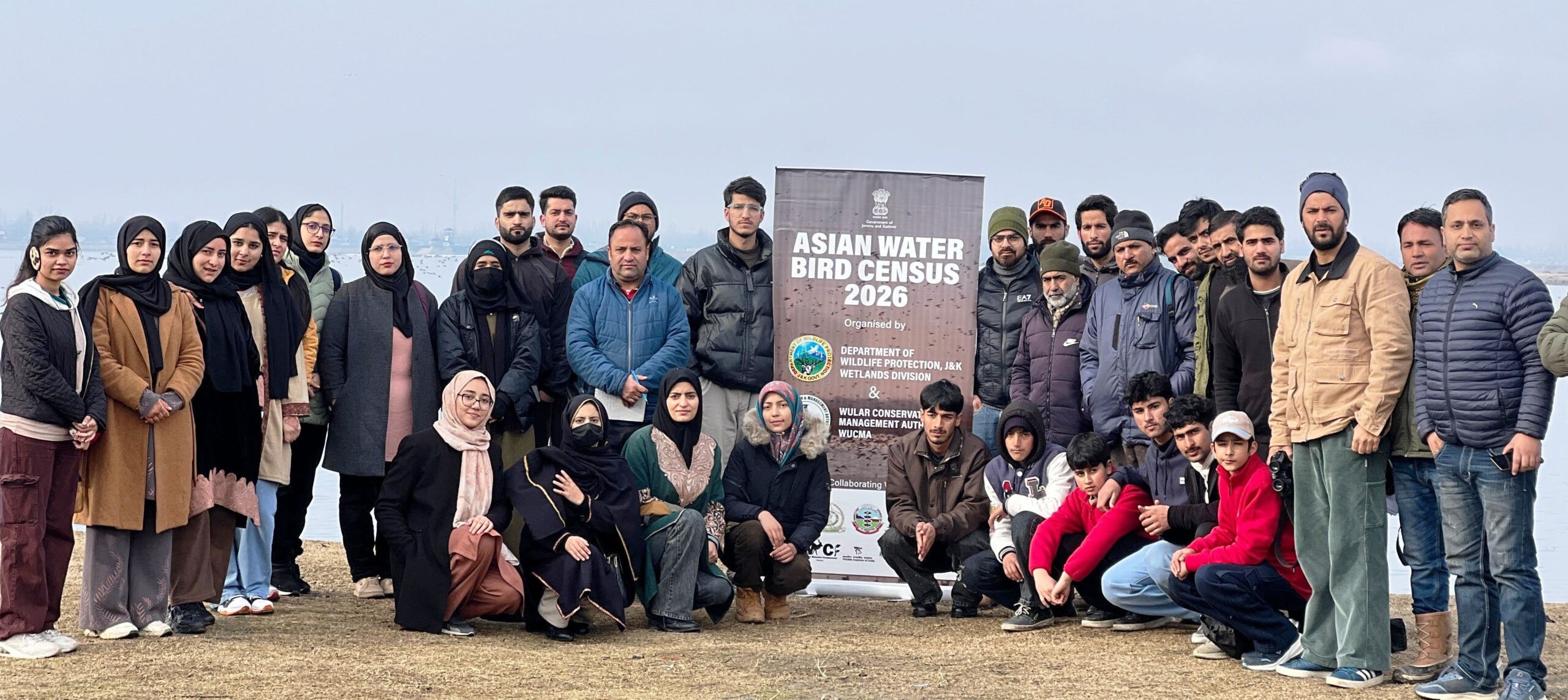
SRINAGAR, FEBRUARY 12: The Asian Waterbird Census (AWC)-2026 was successfully conducted today across 27 wetlands of the Kashmir Valley, marking a major field-based biodiversity monitoring exercise undertaken by the Department of Wildlife Protection, Jammu & Kashmir, through its Wetland Division, Kashmir, in coordination with the Wular Conservation and Management Authority (WUCMA).
The census exercise commenced today, simultaneously covering 58 designated census points spread across north, central and south Kashmir. The field activity followed a brief orientation and preparatory programme organised a day earlier to familiarise participants with standard census protocols and scientific methodologies.
The census covered several ecologically significant wetlands, including Hokersar, Shalbugh, Haigam, Wular Lake, Dal Lake, Anchar Lake, Nigeen Lake, and Chatlam, among other important wetland sites. These wetlands form a critical part of the Central Asian Flyway, serving as wintering and staging habitats for migratory waterbirds arriving from Siberia and Central Asia.
The Asian Waterbird Census is a globally coordinated, citizen-science-based monitoring programme conducted annually across Asia and Australasia. It provides one of the largest long-term datasets on waterbird populations worldwide, supporting international conservation frameworks, wetland management planning, and global biodiversity assessments.
More than 350 participants were actively involved in the field-level census, making AWC-2026 one of the largest participatory conservation exercises conducted in Kashmir in recent years. Participants included scholars and students from Sher-e-Kashmir University of Agricultural Sciences and Technology (SKUAST-Kashmir), particularly the Faculty of Veterinary Sciences and Faculty of Forestry, along with scholars from Environmental Sciences, zoology, botany and allied disciplines of the University of Kashmir. Students from colleges of Srinagar, Ganderbal, and Budgam districts, as well as students from local schools, participated in large numbers.
Conservation NGOs, trained volunteers, birdwatchers, and civil-society groups also played an important role in the successful execution of the census.
Wildlife Warden wetland division, Altaf Hussain stated that the Asian Waterbird Census is not merely an exercise in counting birds, but a scientifically structured estimation process focused on population trends. These trends help assess the suitability of wetlands for migratory and resident waterbirds and serve as vital ecological indicators for sustained wetland management.
Regional Wildlife warden Kashmir, Tawheed Ahmad deva, showing satisfaction said “while early field observations are encouraging, the exact figures and final assessment will be known only after detailed compilation and analysis of data”.
Manzoor Ahmad Qadri, Chief Executive Director, Wular Conservation and Management Authority, said that “strong and encouraging inputs have been received from Wular Lake with regard to the presence of migratory waterbirds. He observed that while significant efforts are still required to restore the old ecological glory of Kashmir’s wetlands, the conservation and restoration interventions undertaken by the Department of Wildlife Protection and WUCMA are beginning to yield positive results”.
The Asian Waterbird Census remains an important annual conservation exercise, providing critical scientific inputs for wetland restoration, biodiversity monitoring, and long-term ecological planning in Jammu and Kashmir.