



Kamran Bhat / JK News Live
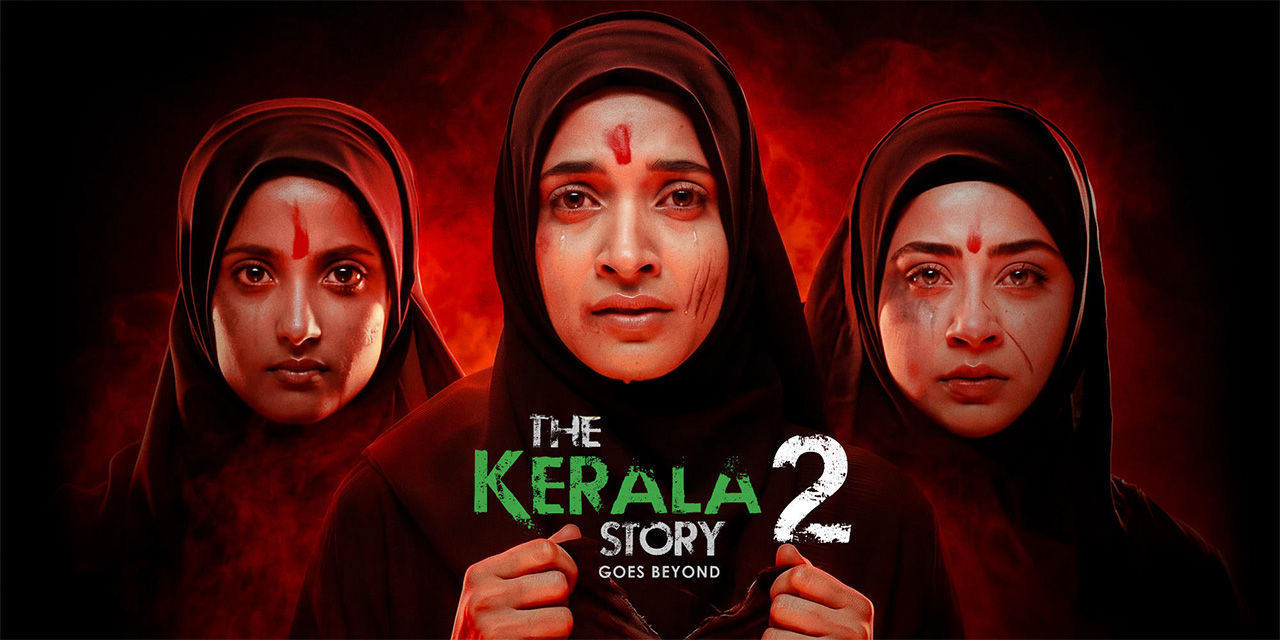
In the dark hallways of cinema theatres across India a disturbing story is being told one in which the magic of moviemaking becomes the gateway for religious hatred. Two recent movies, The Kerala Story 2: Goes Beyond and Dhurandhar, have set off a massive national and international controversy on the weaponization of cinema to promote Islamophobia and Islam’s responsibility for India’s social ills. These are not isolated incidents but the most recent chapters in an alarming trend where the silver screen has become an arena of religious polarization.
On the 27th of February, 2026, The Kerala Story 2: Goes Beyond was due to be released in theatres across the country. However, just one day before the release, the Kerala High Court intervened and blocked the release of the film for 15 days and ordered India’s Central Government to reassess if the movie poses a threat to public order and communal harmony. The intervention of the court followed two residents of Kerala filing petitions claiming that the sequel to the controversial film of 2023 is denigrating their home state and claiming without evidence that it is a hub for Islamic extremism.
The trailer of the film starts with a horrifying announcement: “Insha Allah, in the next 25 years, India will be an Islamic state under Sharia law.” Another title card states, “Our mission is to convert Hindu girls.” The trailer uses the hashtags #SaveYourDaughters and says, “They targeted our daughters.” They broke their trust. They stole their futures. This time we do not remain silent”.
Justice Bechu Kurian Thomas, who was presiding over the case, had serious reservations about the content of the film. He said that if the very material in the teaser “has prima facie potential to distort public perception and disturb communal harmony” then there should be an overall reassessment. The court cited a 1989 Supreme Court decision.
that noted that while a single movie on a social issue may not have significant impact on public attitudes, “continual exposure to films of a similar character will produce a change”
The first Kerala Story film, which came out this year, claimed 32,000 women from Kerala were converted to Islam through “love jihad” a discredited conspiracy theory that claimed Muslim men seduced Hindu women to convert them. The movie showed women being romantically entrapped and forcibly converted and recruited as terrorists for ISIS. After legal challenges made it to India’s Supreme Court, producers were forced to include a disclaimer saying “there is no authentic data to justify any figure of conversion and that the film represents a fictionalised account of events”
While The Kerala Story 2 was coming to the court of law, another movie received international controversy. Dhurandhar, starring Bollywood superstar Ranveer Singh, is a spy thriller which has been banned in six gulf country cooperation nations including Qatar, Bahrain over concerns about its anti-Pakistan and anti-muslim content as per the report from the Muslim Network.
At the purely cinematic level, Dhurandhar is well polished and well-paced. However, from critics, it is said that underneath its glossy exterior is a narrative that fits within a nationalist political framework and tends towards familiar representations that risk perpetuating Islamophobic.
The film places India’s intelligence apparatus in the position of unambiguously moral, efficient, and justified in its actions. In contrast, Pakistan is presented as a hostile force in almost every scenario, with no political nuance or historical context. More worryingly, Dhurandhar links threat and suspicion with Muslim identity repeatedly, in visual cues, character archetypes, as well as narrative shortcuts.
What stands out is the lack of interiority and complexity to Muslim characters, which is a rare occurrence. They exist largely in the service of the plot often as antagonists or facilitators of violence. This pattern has increasingly been the case in Hindi cinema of recent times and Dhurandhar fits snugly into that trend. When the process of representation continues in this direction, it ceases to appear accidental, and begins to appear structural. These two films do not exist in isolation.
They are part of a greater, deeply worrying pattern in Indian cinema. The Kashmir Files (2022), The Kerala Story (2023) and Dhurandhar (2025) have caused controversy by embedding Islamophobic tropes within a narrative that is being presented as a historical/social truth.
According to an analysis published by Frontline magazine, Hindi cinema has evolved a dismaying vocabulary for Muslims. The “Muslim-as-terrorist” trope has become so pervasive it happens that the Muslim character is the driver for the majority of plots involving bombs, conspiracies, and anti-national activities. Visual signs such as shalwar suits, keffiyeh headgear and surma lined eyes are the signs for the audience to see them as an “undistinguished block” and not as individuals.
The portrayal extends to domestic life too Muslim men are depicted as being abusive towards their wives when they are not engaged in terrorism. The “surma-eyes stereotype” of the Muslim man, so often used for antagonists, gangsters or historical rulers, sets them apart as “other.” Perhaps most insidiously, Muslim characters are also often linked to visceral imagery of meat-cutting and butchery to suggest subliminally a predisposition to human violence.
These depictions conjure what critics refer to as a “needle of suspicion” which points firmly at Muslim men that makes the audience feel that they are perpetual threats who need to be “eliminated by the plot.” The narratives allow the majority community to feel intrinsically “innocent” and make majoritarian violence “defensive” while denying the majority the right of self-defence to the minority community
Cinema is a powerful medium. It affects perceptions, influences attitudes and can create or widen divisions. When there are films like The Kerala Story 2 and Dhurandhar being made in which Muslims are referred as existential threats, when there are films that link Islam with terrorism and seduction, they are not creating stories, they are creating hatred.
The intervention of the Kerala High Court to block The Kerala Story 2 brings some ray of hope that the judiciary is aware of the danger. Justice Thomas relied on the Supreme Court’s observation that “continual exposure to films of a similar character will produce a change.”
The court’s decision that “it is constitutionally impermissible for anyone, through any medium, to vilify and denigrate any community or target any particular community, on the basis of religion” is a strong statement against the weaponisation of cinema.
As audiences, we need to be able to enjoy good cinema and still ask the hard questions about the stories films choose to tell and the views they leave out. A genuinely confident film industry should be able to deal with this duality pleasure and criticism can be reconciled.
The Muslim community in India which makes up almost 14% of the population deserves representation that displays their diversity, their contribution to the culture and history of the nation, and their daily humanity. They deserve to be viewed as doctors and teachers, poets and laborers, neighbours and friends not simply as terrorists, conspirators or threats.
As The Kerala Story 2 and Dhurandhar continue to be a subject of controversy, they are a clear reminder that cinema is never just entertainment. It is a mirror which reflects who we are and who we are becoming. The question before Indian cinema today is whether it will continue to show the disfiguring picture of hate, or whether it will choose to show the Truth of India’s multifarious and complex communities in all its human goodness.
Written by Kamran Bhat
Kamranbhatt029@gmail.com