


Inaugurates two day R&D workshop at IIT Jammu
JAMMU, MARCH 24: Emphasising a decisive shift towards outcome-driven research and transparent scientific governance, Commissioner Secretary, Science and Technology Department, Babila Rakwal, on Tuesday said that science in Jammu and Kashmir is being consciously repositioned as a tool of public service delivery rather than remaining confined to academic institutions.
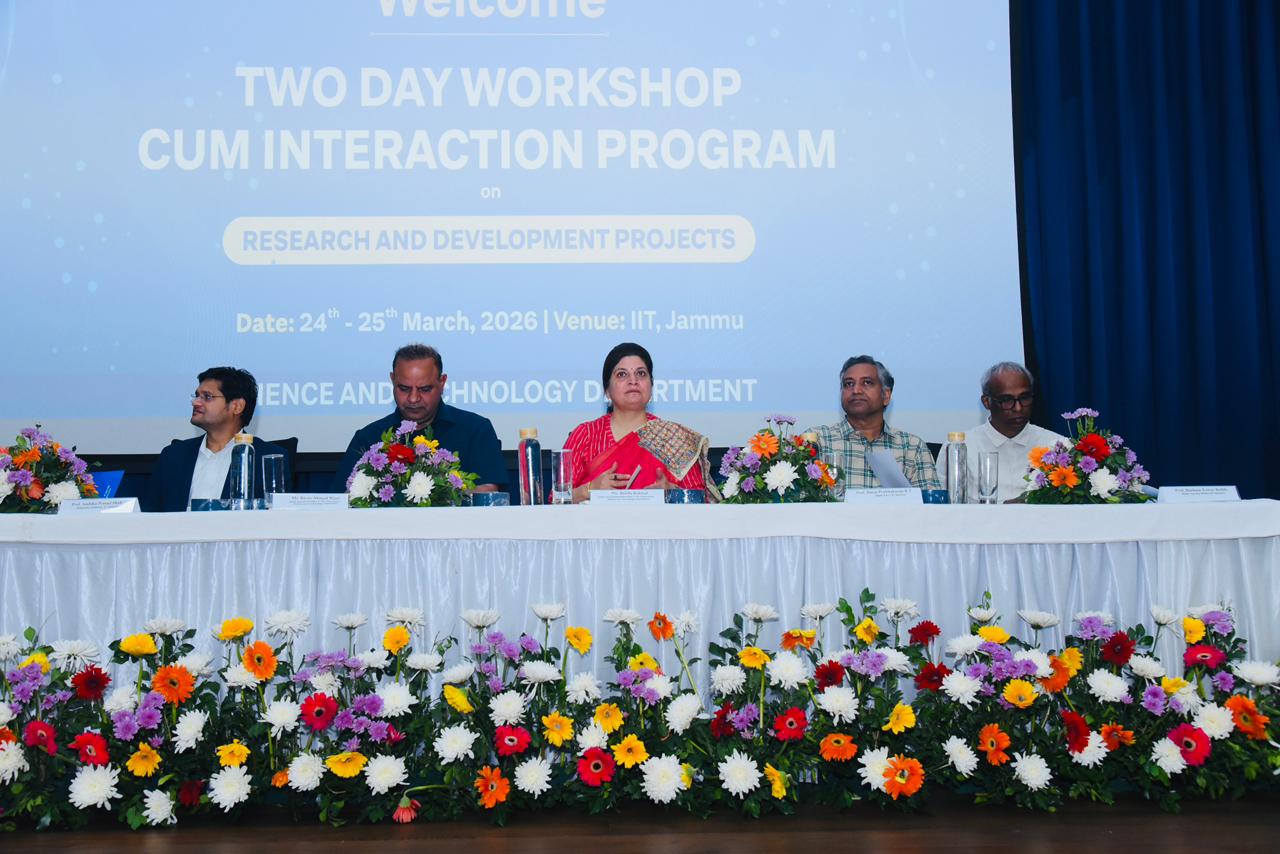
The Commissioner Secretary was speaking at the inauguration of a two day Workshop-cum-Interaction Programme on Research and Development (R&D) projects at the Indian Institute of Technology (IIT) Jammu. The initiative is an exercise that brings together nearly 187 Principal Investigators from across the universities, technical institutions and research bodies of the Union Territory for a structured review of public funded research.
The programme marks one of the most extensive institutional efforts undertaken by the Department to evaluate, streamline and reorient its research support framework, covering a wide spectrum of disciplines. These included agriculture, biotechnology, health sciences, engineering, renewable energy, environmental sciences, climate change and emerging digital technologies.
The inaugural session was followed by a structured sequence, beginning with a documentary showcasing the Department’s interventions in research promotion, scientific outreach, innovation and clean energy across urban, rural and remote regions of Jammu and Kashmir. The session also included release of the Mid-Term Appraisal Report of R&D Projects, launch of online R&D Management portal and distribution of certificates among the beneficiaries under the Science Talent Promotion Scholarship Programme .
Releasing the Mid-Term Appraisal Report, Babila Rakwal said that public funded research must be subject to periodic and rigorous evaluation to ensure that it remains aligned with its objectives and delivers tangible outcomes. She noted that the Department is moving towards a system where monitoring is not treated as a procedural requirement but as an integral component of research governance, ensuring accountability, quality and relevance.
Highlighting the launch of the end-to-end online R&D Project Management Portal, the Commissioner Secretary described it as a major administrative reform that will transform the way research proposals are handled. The portal enables digital submission, structured evaluation, real-time tracking and continuous monitoring of projects, thereby reducing delays, minimising manual intervention and ensuring greater transparency in decision-making.
In her address, Babila Rakwal outlined a comprehensive vision for the future of science and technology in Jammu and Kashmir, stating that research must directly contribute towards improving the governance, strengthening public institutions and addressing the local challenges. She observed that science is increasingly becoming embedded in everyday life, whether through reliable energy access, improved agricultural practices, efficient public infrastructure or enhanced service delivery.
The Commissioner Secretary stressed that the Department’s approach is guided by the principle that research must be relevant, collaborative and outcome-oriented. “The value of research lies not in the number of projects sanctioned but in the impact they create on the ground,” she said, calling upon the researchers to focus on practical applications, interdisciplinary collaboration and policy relevance.
Underscoring the importance of skill development, the Commissioner Secretary said that building a capable and future ready talent base is essential for sustaining innovation. She emphasised that the Department is committed towards nurturing scientific aptitude at multiple levels, from school education to advanced research and to linking knowledge with employability, entrepreneurship and community engagement.
The Commissioner Secretary also reiterated the Department’s commitment to sustainable and environmental responsibility. She noted that scientific interventions must contribute to cleaner energy systems, efficient resource utilisation and ecological balance, particularly in a region with fragile ecosystems and diverse geographical challenges.
Referring to the Department’s renewable energy initiatives, she said that large-scale solarisation of Government buildings, promotion of solar agricultural pumps, expansion of solar lighting in rural areas and development of Small Hydro Power projects are not only contributing to energy security but also reducing expenditure and supporting environmental conservation.
On the research and innovation front, she highlighted that institutional support is being strengthened through funding of R&D projects, development of scientific infrastructure and expansion of outreach activities. Facilities such as Regional Science Centres, Innovation and Dissemination Centres and Biotechnology Parks are being developed as platforms to support innovation, incubation and dissemination of knowledge.
Importantly, she emphasised the need for transparency and a structured roadmap in the selection and monitoring of research projects. She stated that objective criteria, peer review mechanisms and alignment with priority sectors will guide project approvals, ensuring that public funds are utilised efficiently and yield measurable outcomes. She added that this approach will strengthen confidence among researchers and institutions while enhancing the credibility of the system.
Describing the workshop as both an academic and administrative milestone, the Commissioner Secretary said that it provides a unique platform for direct interaction between researchers, experts and policymakers. Unlike conventional file-based reviews, the programme enables investigators to present their work, engage with expert panels and receive constructive feedback, thereby improving the quality of evaluation and strengthening accountability.
The workshop draws upon a large and diverse portfolio of Department-supported research projects, many of which address practical challenges in areas such as agriculture, health, environment, energy, water management, digital systems and climate resilience. These projects, officials said, are increasingly focused on generating solutions that can be translated into field-level applications and policy interventions .
The inaugural session concluded with a vote of thanks after the felicitation of experts associated with third-party evaluation of R&D projects and distribution of scholarship certificates.