



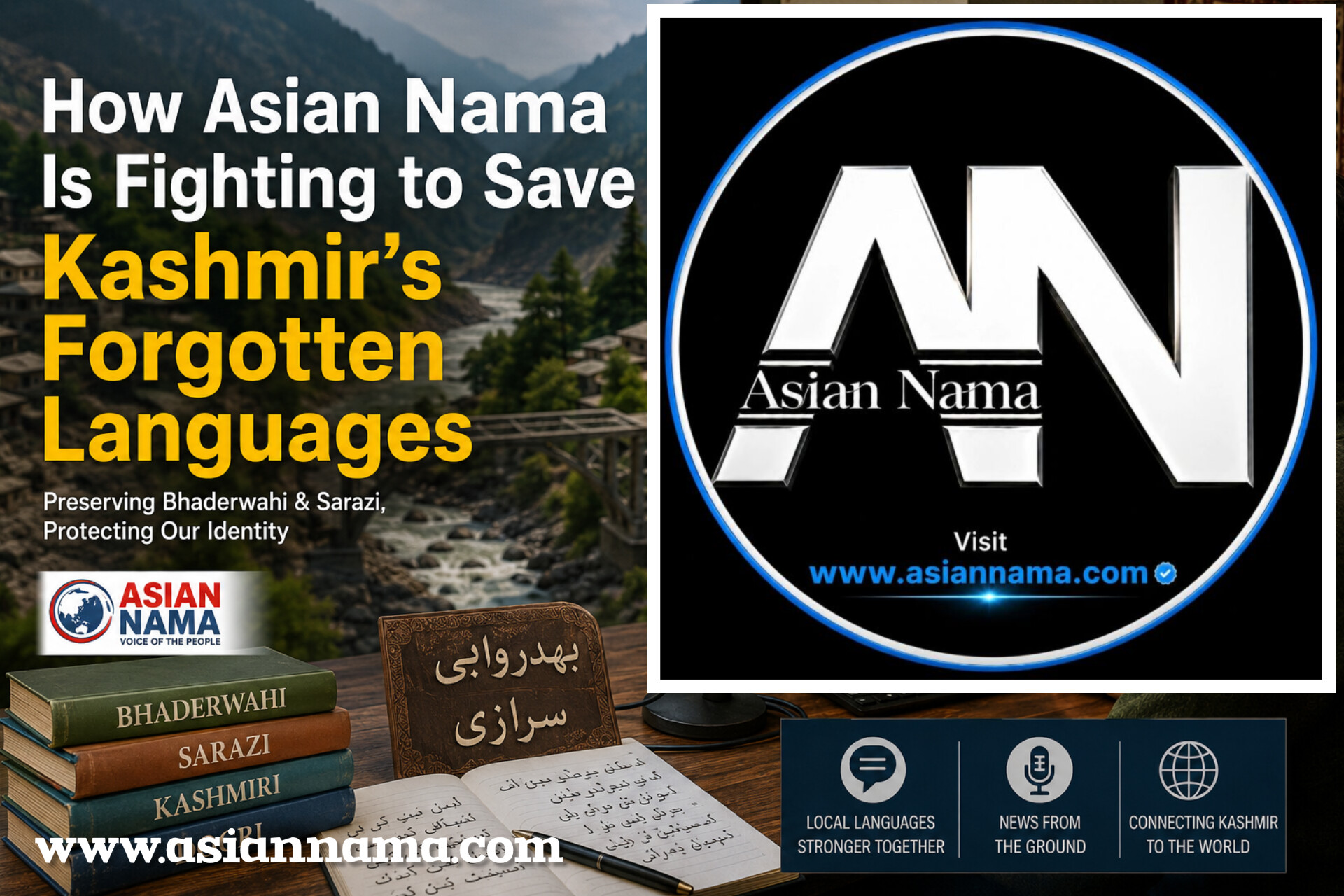
Jammu & Kashmir | India: In the remote mountains of Jammu’s Chenab Valley, where ancient languages echo through villages surrounded by rivers and forests, a young digital media platform is quietly leading a cultural movement.
Asian Nama, a growing multimedia news platform founded by journalist Ehsaan Yousf, is not only reporting the news — it is preserving identity, protecting heritage, and giving endangered regional languages a digital future.
At a time when globalisation and modern media are rapidly pushing smaller languages toward extinction, Asian Nama has chosen a different path: speaking to people in the language of their roots.
Operating from the Doda region of Jammu & Kashmir, the platform produces news content in Bhaderwahi and Sarazi — two indigenous languages of the Chenab Valley that now face the risk of fading away with time. Through daily video bulletins, local reporting, documentaries, and social media storytelling, Asian Nama has become one of the few digital platforms actively using these languages in journalism.
The initiative gained stronger purpose after the passage of the Jammu and Kashmir Official Languages Bill, which declared Hindi, Kashmiri, and Dogri as official languages of the Union Territory. While the move was welcomed in some circles, many communities in Chenab Valley expressed concern over the growing neglect of smaller regional languages and scripts traditionally connected to the region’s cultural identity.
For Ehsaan Yousf, the issue was not merely political — it was deeply personal.
“Our languages are not just words; they carry our history, emotions, traditions, and identity. If a language disappears, a part of our heritage disappears with it,” he says.
According to census estimates, only a limited number of speakers remain for both Bhaderwahi and Sarazi. In many families, younger generations are increasingly shifting toward Urdu, Hindi, or English for education and communication, leaving native languages vulnerable to decline.
Asian Nama aims to change that narrative.
Every day, the platform releases news updates first in Urdu and then in Bhaderwahi and Sarazi, allowing local communities to hear current affairs in the language spoken at home. For many viewers, it is the first time they have seen professional digital journalism presented in their mother tongue.
The platform’s work extends far beyond language preservation. Asian Nama also focuses on hyper-local reporting from remote areas often ignored by mainstream media. From road connectivity problems and water shortages to healthcare concerns, education challenges, and unemployment, the team highlights issues directly affecting ordinary people in the Chenab region.
Armed with cameras, mobile phones, and determination, the reporters travel to distant villages to document ground realities. Their journalism is deeply connected to the community, giving a voice to people whose stories rarely reach larger media platforms.
Before becoming a news organization, the team behind Asian Nama initially worked on promoting tourism in the Chenab Valley through photography and videography. Their goal was to showcase the breathtaking beauty of unexplored destinations hidden within the mountains of Doda and Bhaderwah — areas rich in culture and natural landscapes but lacking proper infrastructure and national attention.
Over time, that creative initiative transformed into a broader media mission.
Today, Asian Nama is steadily building its identity as a modern people-centric digital platform that combines journalism, culture, and community engagement. Through YouTube, social media, and online reporting, the organization is connecting local voices with audiences across India and abroad.
For the Kashmiri and Chenab diaspora living overseas, the platform has also become a cultural connection to home — a reminder of language, tradition, and regional identity in an increasingly globalized world.
Despite limited resources, the vision continues to grow. Ehsaan dreams of one day expanding Asian Nama into a full-scale multimedia and print organization dedicated to independent journalism and regional storytelling.
“The strength of our journalism lies in our local language,” he says. “This is not only news reporting — this is a way of reclaiming our identity.”
In an age where many smaller languages are disappearing silently, Asian Nama represents something rare: a digital newsroom using journalism not just to report events, but to protect culture itself.
From the mountains of Chenab Valley to audiences across the world, Asian Nama is proving that even the smallest voices deserve to be heard.